Peers, related companies and track record
A number means more beside other numbers. On a stock's Overview, three cards place the company among its neighbors: Against its peers puts the key figures side by side, Related companies finds other companies by several measures of similarity, and the side column shows which funds hold it.
#Against its peers
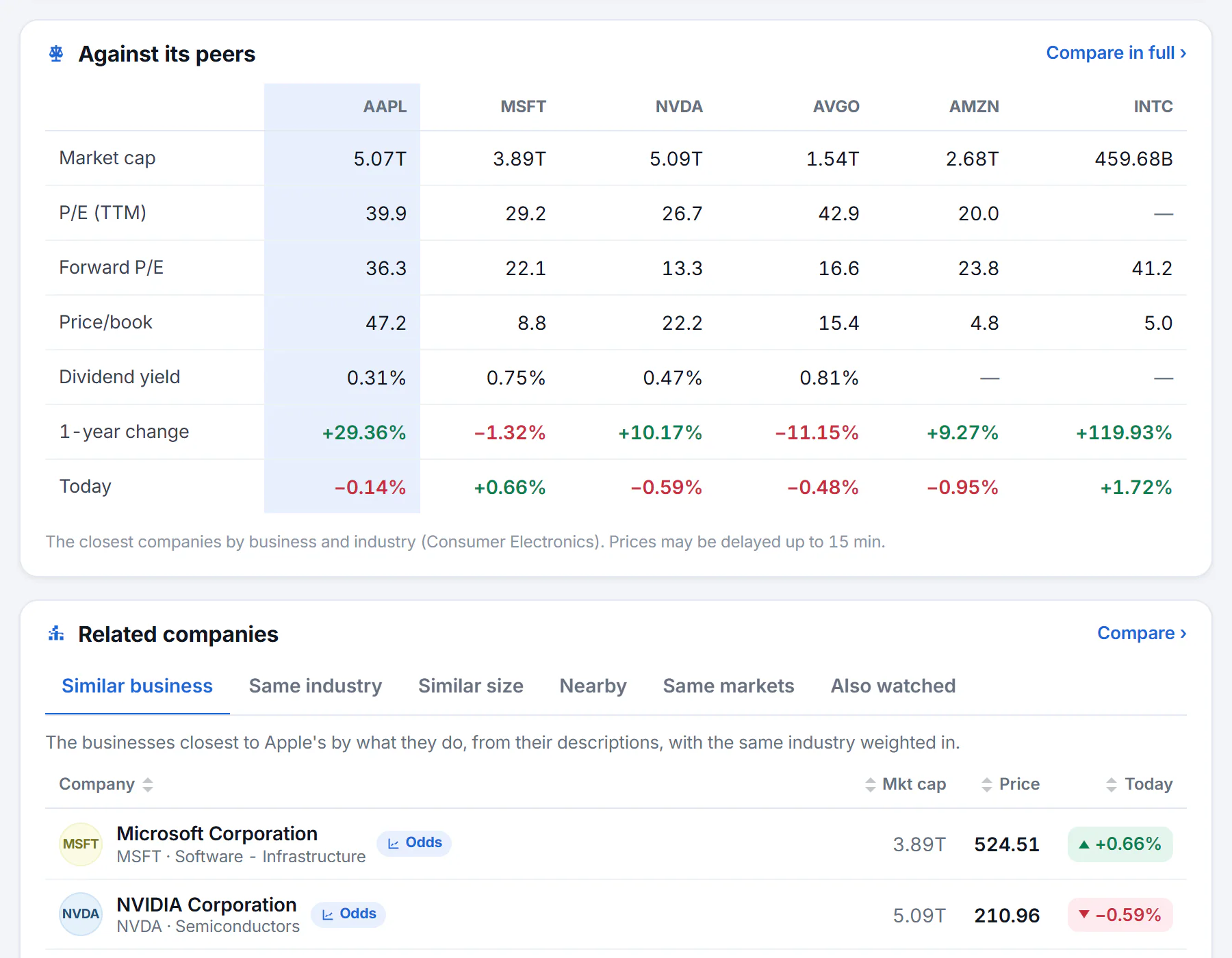
The stock is the shaded column. Its closest companies follow, on the same measures.
- 1The stock you are looking at
- 2Compare in full
- 3Choose how companies are related
- 4Prediction markets about this company
The first column is the stock you are viewing, shaded. The next columns are its closest companies by what they do and the industry they are in, up to five. The rows are the figures most often used to size up a company: market cap, P/E (trailing and forward), price to book, dividend yield, the change over a year and the change today. A dash means the figure is not available for that company.
Select a ticker to open that company's page, or Compare in full to open all of them on the comparison page. See Compare stocks. The terms are explained in Key statistics, explained.
#Related companies
The Related companies card finds companies several ways, one tab each. Which tabs appear depends on what is known about the company:
- Similar business: companies whose business descriptions are closest to this one's, with the same industry weighted in.
- Same industry: companies in the same industry.
- Similar size: companies of about the same market value.
- Nearby: companies headquartered close by.
- Same markets: companies that serve the same kinds of customers or regions.
- Moves together: companies whose prices have moved together over the past year, where there is enough history to tell.
- Also watched: companies that people who look at this one also look at.
A line above each table says how the list was made. Each row shows the company, its market cap, its price and today's change. Compare opens the first few on the comparison page.
An Odds label beside a company means prediction markets have markets about it; see Prediction-market odds.
For a fund the card is called Similar funds, and for others it may be People also watch.
#Funds that hold it
In the side column, Funds that hold it lists the funds with the biggest stake in the stock, with the share of each fund the stock makes up. The figures come from the fund companies' own daily holdings files. Select a fund to open its page.
#Track record
Track record counts how often the stock has made the day's lists of top gainers, top losers and most active, over the last 30 days and the last year, together with the best rank it reached. A today badge marks a list it is on now. It also shows how many articles have named it in the last 24 hours, 7 days and 30 days and the sentiment over 30 days. The lists and how they are counted are explained in The Leaderboard.
A note under the table says when a stock cannot make some lists, for example small-company lists for a large company.
#Common questions
Why is there no peers table on some stocks?
It needs at least two close companies to compare with. A stock the index knows little about may have none.
Are these companies recommendations?
No. They are companies that are similar by the measures named above. Similar does not mean a good choice.
How is "similar business" decided?
By comparing what each company says it does, so two companies with alike descriptions come out close. The page says so above the list.